
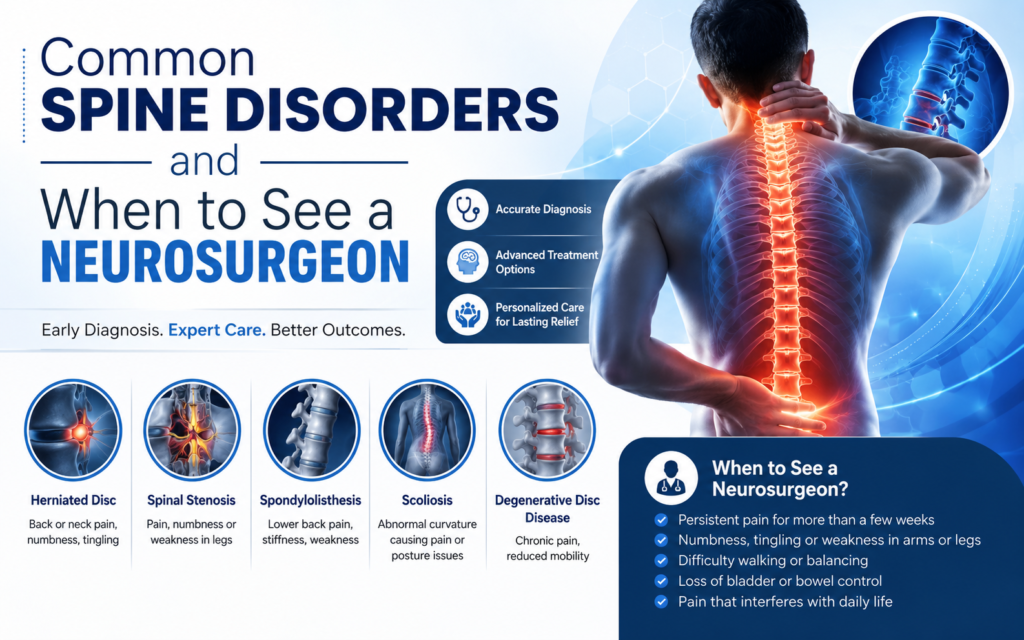
Common Spine Disorders and When to See a Neurosurgeon
The spine is one of the most important structures in the human body, providing support, flexibility, and protection to the spinal cord. It enables us to stand, walk, bend, and perform everyday activities while serving as the primary pathway for communication between the brain and the rest of the body. However, due to aging, injuries, poor posture, lifestyle habits, or degenerative conditions, the spine can develop disorders that significantly impact mobility and quality of life. While occasional back or neck pain is common, persistent pain accompanied by neurological symptoms may indicate a more serious spinal condition that requires expert evaluation. Understanding the most common spine disorders and knowing when to consult a neurosurgeon can help ensure timely diagnosis and effective treatment.
Back pain is one of the leading causes of disability worldwide, affecting millions of people every year. Although many cases improve with rest, physiotherapy, and medication, some spine conditions progress over time and require specialized medical care. Ignoring persistent pain or neurological symptoms may lead to permanent nerve damage or reduced mobility. Early diagnosis allows for better treatment outcomes and, in many cases, helps avoid more complex surgical procedures.
One of the most frequently diagnosed spine disorders is a herniated disc, also known as a slipped or ruptured disc. The spinal discs act as cushions between the vertebrae, absorbing shock and allowing smooth movement. When the outer layer of a disc weakens or tears, the soft inner material can bulge outward and compress nearby nerves. This often results in severe back or neck pain, numbness, tingling, muscle weakness, or pain that radiates into the arms or legs. Patients with lumbar disc herniation commonly experience sciatica, a sharp pain that travels from the lower back down the leg. While conservative treatment may relieve symptoms in many patients, persistent nerve compression may require surgical intervention to prevent permanent nerve damage.
Another common condition is spinal stenosis, which occurs when the spaces within the spinal canal become narrower, placing pressure on the spinal cord or surrounding nerves. This condition is more common in older adults due to age-related degeneration but can also result from arthritis, spinal injuries, or congenital abnormalities. Individuals with spinal stenosis often complain of lower back pain, numbness in the legs, difficulty walking, poor balance, and muscle weakness. Symptoms typically worsen while standing or walking for long periods and improve after sitting or bending forward. If left untreated, severe spinal stenosis can interfere with daily activities and significantly reduce mobility.
Degenerative disc disease is another age-related condition that affects the spine. Over time, spinal discs naturally lose water content, becoming thinner and less flexible. As the cushioning between vertebrae decreases, patients may develop chronic back or neck pain, stiffness, reduced flexibility, and nerve irritation. Although degeneration is a normal part of aging, some individuals experience severe pain that limits their ability to work or perform daily tasks. Treatment usually begins with medication, physical therapy, posture correction, and lifestyle modifications. In advanced cases where conservative measures fail, surgery may be recommended to relieve pain and stabilize the spine.
One of the most recognizable spinal disorders is sciatica, which is not a disease itself but a symptom caused by compression or irritation of the sciatic nerve. This large nerve extends from the lower back through the hips and into each leg. Patients often describe sciatica as a sharp, burning, or electric shock-like pain radiating from the lower back into one leg. Tingling, numbness, and muscle weakness may accompany the pain. Sciatica is commonly caused by herniated discs, spinal stenosis, or bone spurs. Persistent symptoms that interfere with walking or daily activities should be evaluated by a spine specialist.
Cervical spondylosis, commonly known as neck arthritis, is another widespread spinal condition that develops as the cervical spine ages. Wear and tear of the discs, joints, and bones in the neck can lead to chronic neck pain, stiffness, headaches, shoulder pain, and numbness in the hands or fingers. In severe cases, pressure on the spinal cord may affect walking, balance, and coordination. Early medical evaluation helps determine whether conservative management or surgical treatment is appropriate.
Some patients develop spinal tumors, which are abnormal growths that may occur inside or around the spinal cord. These tumors may be benign or malignant and can compress the spinal cord or nerves as they grow. Common symptoms include persistent back pain that worsens at night, weakness in the arms or legs, difficulty walking, numbness, and changes in bladder or bowel function. Although spinal tumors are relatively uncommon, they require prompt diagnosis because early treatment significantly improves outcomes.
Spinal fractures are another serious condition that often results from trauma, falls, road accidents, or osteoporosis. Compression fractures are particularly common among elderly individuals with weakened bones. Symptoms include sudden severe back pain, limited movement, spinal deformity, and nerve-related symptoms if the fracture affects the spinal cord. Depending on the severity, treatment may involve bracing, minimally invasive procedures, or surgical stabilization.
Many spine disorders can initially be managed without surgery. Conservative treatment options include medications to reduce pain and inflammation, physiotherapy to strengthen muscles and improve flexibility, activity modification, weight management, posture correction, and image-guided injections for pain relief. Advances in minimally invasive spine surgery have also transformed patient care by reducing incision size, minimizing blood loss, shortening hospital stays, and promoting faster recovery. These modern techniques allow many patients to return to normal activities much sooner than traditional open surgery.
Knowing when to consult a neurosurgeon is essential. While mild back pain often improves with rest, certain symptoms require immediate specialist evaluation. Persistent back or neck pain lasting more than six weeks, pain radiating into the arms or legs, numbness, tingling, muscle weakness, difficulty walking, loss of balance, or reduced coordination should never be ignored. Emergency medical attention is necessary if a patient experiences sudden loss of bladder or bowel control, severe weakness in the limbs, or paralysis, as these may indicate significant spinal cord compression requiring urgent treatment.
During consultation, a neurosurgeon performs a detailed neurological examination and may recommend imaging studies such as X-rays, MRI scans, CT scans, or nerve conduction studies to accurately identify the underlying condition. Once the diagnosis is confirmed, a personalized treatment plan is developed based on the patient’s age, symptoms, lifestyle, and overall health. The primary goal is always to relieve pain, preserve neurological function, restore mobility, and improve quality of life while recommending surgery only when absolutely necessary.
Maintaining a healthy spine is equally important for preventing spinal disorders. Regular exercise strengthens the muscles supporting the spine, while maintaining proper posture reduces unnecessary stress on the vertebral column. Avoiding prolonged sitting, lifting heavy objects correctly, maintaining a healthy body weight, quitting smoking, and ensuring adequate calcium and vitamin D intake all contribute to better spinal health. Regular health check-ups also help identify age-related spinal changes before they become severe.
In conclusion, spine disorders can range from mild discomfort to serious neurological conditions that significantly affect daily life. Persistent back or neck pain, radiating pain, numbness, muscle weakness, balance problems, or changes in bladder and bowel function should never be ignored. Early diagnosis, timely medical intervention, and appropriate treatment can prevent complications and improve long-term outcomes. Whether the condition requires conservative care or advanced minimally invasive spine surgery, consulting an experienced neurosurgeon at the right time ensures the best opportunity for recovery and a healthier, pain-free life.